A reminder to self: As the title implies, it’s OK to have an empty statement in Verilog. This is useful in order to make all the following clauses active only if the first condition isn’t met. This is commonly seen in C, but I wasn’t sure if it’s OK to do this in Verilog too. [...]
Oh my goodness I’ll say this from the start: This is me babbling. You have been warned. Don’t expect anything coherent in this post. Not that I necessarily keep things very tidy in my other posts, but this one is clearly me typing at full speed, not trying to be organized or anything. I’ll buy [...]
I’ve been a bit silent on this blog for a while, but that’s only because I’ve been busy writing on my spin-off site lately. So here are a few posts over there which are pretty much related to what I do on this blog. These pages are also translated to Chinese, Japanese and Korean, so [...]
Every now and then Vivado whines with [Common 17-356] Failed to install all user apps. And every time I’m looking up how to to solve this, and then I find that the command that fixes this is tclapp::reset_tclstore in the Tcl command window. And then quit Vivado, and start it again. Why? I’ll never know. [...]
Due to rather peculiar reasons described in this post, I found myself looking for all QSF parameter names that Quartus recognizes. I ended up searching a binary file in Quartus’ installation directory. So this is by no means an authoritative list, but since I made it, I thought I should post it. Just in case [...]
Due to rather peculiar reasons described in this post, I found myself looking for all QSF parameter names that Quartus recognizes. I ended up searching a binary file in Quartus’ installation directory. So this is by no means an authoritative list, but since I made it, I thought I should post it. Just in case [...]
Introduction This post summarizes some scattered findings I made while trying to make a Cyclone 10′s signal detect feature work properly for detecting a SuperSpeed USB LFPS signal. As it turned out, Cyclone 10′s transceiver isn’t capable of this, as explained below. But since the documentation on this issue was lacking, I resorted to reverse [...]
Introduction Checking Xillybus’ bundle for Kintex Ultrascale+ on Vivado 2020.1, I got several critical warnings related to the PCIe block. As the bundle is intended to show how Xillybus’ IP core is used for simplifying communication with the host, these warnings aren’t directly related, and yet they’re unacceptable. This bundle is designed to work with [...]
Introduction This is my short war story as I made Xilinx’ Impact, part of ISE 14.7, work on a Linux Mint 19 machine with a v4.15 Linux kernel. I should mention that I already use Vivado on the same machine, so the whole JTAG programming thing was already sorted out, including loading firmware into the [...]
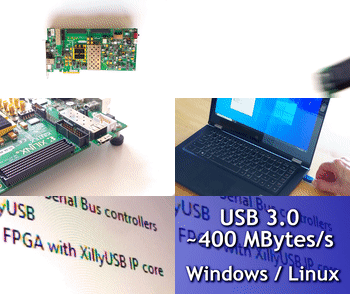
Introduction As the title implies, this post compares two solutions for connecting an FPGA to a host via USB 3.0: Cypress’ FX3 chipset, which has been around since around 2010, and the XillyUSB IP core, which was released in November 2020. Cypress has been acquired by Infineon, but I’ll stick with Cypress. It’s not clear [...]